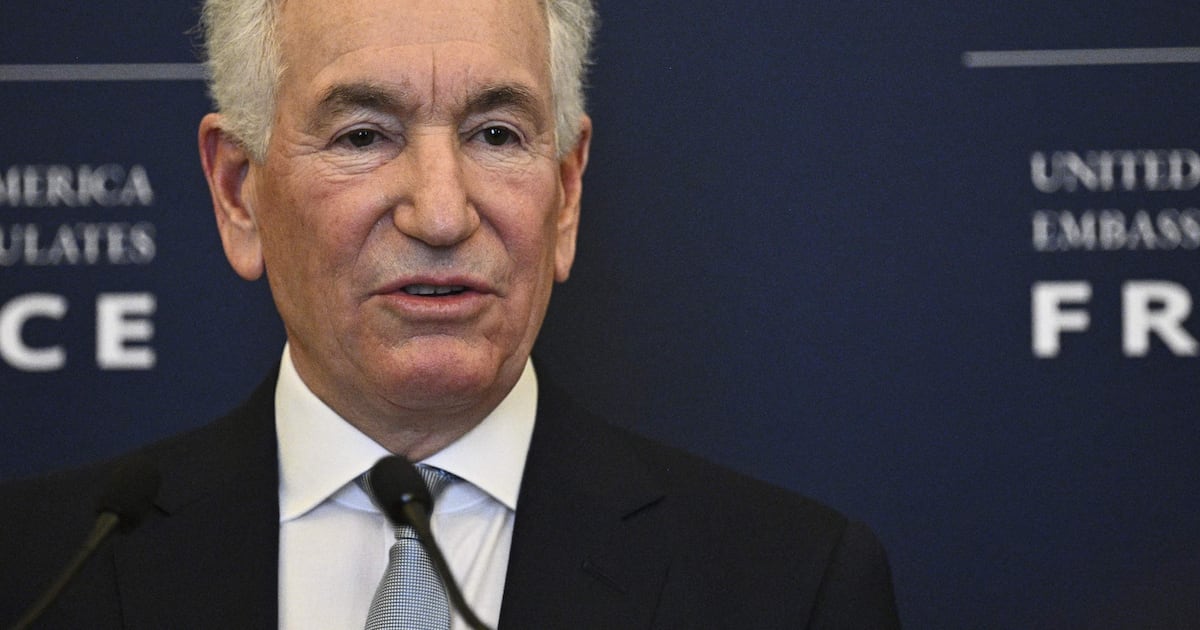
Kushner's Diplomatic Snub: French Foreign Minister Barrot on U.S. Envoy's Access
In a rare and striking display of diplomatic friction, U.S. Ambassador to France, Charles Kushner, ignited a significant spat with the French government after failing to attend a summoned meeting with French Foreign Minister Jean-Noël Barrot. The incident, which unfolded against a backdrop of contentious remarks from the U.S. administration, has cast a spotlight on the intricate etiquette of international relations and the firm stance of France regarding its national sovereignty. Barrot's subsequent declaration that Ambassador Kushner would be denied access to French government officials until he honored the summons marks a serious escalation, underscoring the vital role of diplomatic protocol in maintaining amicable international ties.
The Diplomatic Fallout: A Refusal to Meet
The core of the recent diplomatic imbroglio lies in U.S. Ambassador Charles Kushner's non-attendance at a crucial meeting scheduled with French Foreign Minister Jean-Noël Barrot. Summoned on Monday evening by the head of French diplomacy, Ambassador Kushner's absence was not merely an oversight but a perceived snub that swiftly drew a stern rebuke from Paris. Barrot, speaking to public broadcaster France Info, articulated the French government's dismay, describing the failure to appear as "a surprise" and a direct affront to established diplomatic norms.
The implications of this refusal are not trivial. Barrot unequivocally stated that Kushner's no-show would "naturally, affect his capacity to exercise his mission in our country." For an ambassador, whose primary role is to serve as a conduit between their sending state and the host nation, access to government officials is the bedrock of their effectiveness. Barrot left no room for ambiguity: "For an ambassador to be able to do his job he needs access to members of the government. That's the basics." The U.S. Embassy, meanwhile, remained conspicuously silent, offering no immediate response to repeated requests for comment from the Associated Press, further fueling the narrative of a breakdown in communication.
This incident is not an isolated one, but rather part of a pattern of friction between Ambassador Kushner and the French government. Just months prior, in August, Kushner was also summoned by Paris over a controversial letter he addressed to French President Emmanuel Macron, which alleged insufficient efforts by France to combat antisemitism – accusations the French foreign ministry deemed "unacceptable." These recurring episodes highlight a persistent challenge in the diplomatic relationship, where perceived oversteps by the ambassador have repeatedly tested the patience and protocol of his host nation.
Understanding the Role of the French Foreign Minister
To fully grasp the gravity of Ambassador Kushner's snub, it is essential to understand the institutional weight and historical significance behind the office of the French Foreign Minister. The position, formally known as the Minister of Europe and Foreign Affairs, is the chief architect and executor of France's foreign policy. This venerable office, initially formed in 1547, operates under the direct jurisdiction of the Government of France, symbolizing centuries of diplomatic tradition and strategic international engagement.
The ministry's headquarters, the Hôtel du ministre des Affaires étrangères, located at 37 Quai d'Orsay in Paris, is so synonymous with French diplomacy that "Quai d'Orsay" itself is often used as a metonym for the foreign ministry. This historical continuity and institutional prestige lend immense authority to the statements and actions of the incumbent French Foreign Minister. Jean-Noël Barrot, in his capacity as the current agency executive, represents the voice of French sovereignty and its commitment to international law and protocol.
When the French Foreign Minister issues a summons to an ambassador, it is not a casual request but a formal demand for explanation and accountability. It signifies that the host nation perceives a serious breach of diplomatic conduct or an intervention in its internal affairs that necessitates a direct and high-level response. To ignore such a summons is to disrespect not just the individual minister but the entire institutional framework of French foreign policy and, by extension, the sovereignty of the French Republic. This context underscores why Barrot's response was so firm and uncompromising, as he acts to uphold the dignity and operational integrity of French diplomacy.
Why the Summons? U.S. Interference in French Domestic Affairs
The immediate catalyst for the French Foreign Minister's summons was a series of comments from the Trump administration that France vehemently objected to, viewing them as an unacceptable interference in its domestic political debate. Specifically, the controversy stemmed from a post by the U.S. State Department's Counterterrorism Bureau on X (formerly Twitter). The post asserted that "violent radical leftism is on the rise and its role in Quentin Deranque's death demonstrates the threat it poses to public safety." This statement directly referenced the tragic beating death of Quentin Deranque, a 23-year-old far-right activist who died after clashes between far-left and far-right groups in Lyon.
Compounding the issue, the U.S. Embassy in Paris then reposted this statement, in French, thereby amplifying the message and making it an official U.S. diplomatic pronouncement within French territory. For the French government, this was a clear overstep. French Foreign Minister Jean-Noël Barrot minced no words in expressing France's indignation: "We must have an explanation with him. We don't accept that foreign countries can come and interfere, invite themselves, into the national political debate."
France, like any sovereign nation, guards its internal affairs fiercely. The U.S. administration's characterization of a domestic incident, particularly one as sensitive as political violence and its ideological roots, was seen as an attempt to inject itself into a highly charged national discussion. This constitutes a violation of the principle of non-interference in the internal affairs of other states, a cornerstone of international law and diplomatic relations. Barrot's firm stance reflects a broader French principle that foreign powers should not dictate or comment on their internal political landscape. Such actions can erode trust and complicate the ability of the ambassador to effectively represent U.S. interests without being perceived as a partisan actor within French society. For a deeper dive into France's position on this, read our article: France's Barrot Rejects U.S. Interference in National Debate.
Consequences and the Future of U.S.-France Relations
The immediate consequence of Ambassador Kushner's failure to appear is his declared loss of access to French government officials. As French Foreign Minister Barrot succinctly put it, "When these explanations have taken place, then the U.S. ambassador in France will, naturally, regain access to members of the French government." Until then, Kushner faces a significant impediment to fulfilling his duties, effectively rendering him unable to perform the core functions of his ambassadorship in France. An ambassador without access to the host government is an ambassador with severely curtailed influence and operational capacity.
Barrot was careful to draw a distinction between the ambassador's personal conduct and the broader bilateral relationship, asserting, "Not showing up is his personal responsibility... It does not affect the relationship between France and the United States in any way." While this is a common diplomatic maneuver to limit damage, such incidents inevitably cast a shadow. Trust and mutual respect are foundational to strong international ties, and repeated perceived slights can chip away at that foundation. The French government's firm response, including Barrot's declaration to sanction the U.S. Ambassador, sends a clear message about the sanctity of diplomatic protocol. More details on this can be found in our related piece: French Foreign Minister Barrot Sanctions U.S. Ambassador.
Looking ahead, the incident underscores the need for robust diplomatic communication and a deep understanding of cultural and political sensitivities. While high-level bilateral relations between the U.S. and France are complex and resilient, such diplomatic snubs create unnecessary friction. The onus is now on Ambassador Kushner to comply with the summons, offer the required explanations, and work to rebuild the necessary trust and access to effectively represent U.S. interests in France. This period will test the diplomatic agility of both sides to ensure that this particular spat does not metastasize into a deeper, more enduring chill in one of the world's most enduring alliances.
Navigating Diplomatic Protocol: Lessons for Ambassadors
The unfortunate episode involving Ambassador Kushner and the French Foreign Minister offers invaluable lessons on the critical importance of diplomatic protocol and the nuanced art of international representation. For any ambassador, successfully navigating the complexities of a host nation's political and social landscape requires a delicate balance of advocacy, respect, and adherence to established norms.
- Respect for Host Nation Sovereignty: Ambassadors are guests in a foreign land. Their mandate is to represent their country's interests, not to interfere in the domestic politics of the host nation. Comments on internal affairs, especially those that are politically charged, are almost universally seen as breaches of sovereignty.
- Understanding Cultural and Political Nuances: What might be acceptable discourse or a standard tweet in one country could be deeply offensive or perceived as an intervention in another. A deep understanding of the host country's history, political sensitivities, and cultural norms is paramount.
- The Importance of Communication and Compliance: When a host government, particularly through its French Foreign Minister or equivalent, issues a summons, it is a formal request for dialogue. Even if there are disagreements, complying with the summons is a basic act of diplomatic courtesy and respect. Refusal can escalate a minor issue into a major incident.
- Maintaining Access as a Priority: An ambassador's most vital asset is their access to key government officials, policymakers, and influencers in the host country. Actions that jeopardize this access directly undermine their ability to perform their duties and advocate for their nation's interests.
- Crisis Management and Public Relations: In an age of instant communication, embassies must be adept at crisis management. A clear, measured response to controversies, or even a respectful silence when appropriate, is crucial. Lack of response can be interpreted negatively and exacerbate tensions.
- The Personal vs. the Professional: While ambassadors represent their nation, their actions are often seen as extensions of their government's policy. Drawing a clear line between personal opinions and official statements is critical, as is ensuring that personal conduct does not compromise the broader diplomatic relationship.
Ultimately, the role of an ambassador is one of facilitator and bridge-builder. When protocol is neglected or sovereignty is challenged, it introduces friction that can harm not only individual careers but also the crucial relationships between nations.
The diplomatic standoff between U.S. Ambassador Charles Kushner and French Foreign Minister Jean-Noël Barrot serves as a potent reminder of the fragility and formality inherent in international relations. Barrot's firm stance, rooted in centuries of French diplomatic tradition and the principle of national sovereignty, highlights the critical importance of adherence to protocol. While the incident is officially categorized as a personal responsibility of the ambassador, its implications underscore the delicate balance required to maintain robust bilateral ties. Moving forward, the resolution of this impasse will not only require Ambassador Kushner's compliance but also a renewed commitment from both sides to mutual respect and clear communication, ensuring that fundamental disagreements do not overshadow the enduring strategic partnership between France and the United States.